
Let’s settle something before we get started.
You probably don’t need a $100+ cooking thermometer.
You also probably don’t need a $60 thermometer.
Technically, you can cook chicken by following the clock. You can cook steak by pressing it with your finger. You can guess whether your oil is hot enough. You can even open the oven door every ten minutes and hope everything is going according to plan.
But there is a problem with all of that.
Guessing is terrible for consistency.
And that is where ThermoWorks gets interesting.
ThermoWorks has spent years building a reputation around one deceptively simple idea: if temperature matters to the result, measure it properly.
The company has become particularly well known for the Thermapen family, but its lineup has expanded far beyond instant-read thermometers. Today, you can find affordable everyday thermometers, premium instant-read models, wireless BBQ probes, leave-in alarms, infrared thermometers and specialized temperature tools.
And 2026 is actually a particularly interesting year to review the brand.
Why?
Because ThermoWorks has been changing its lineup.
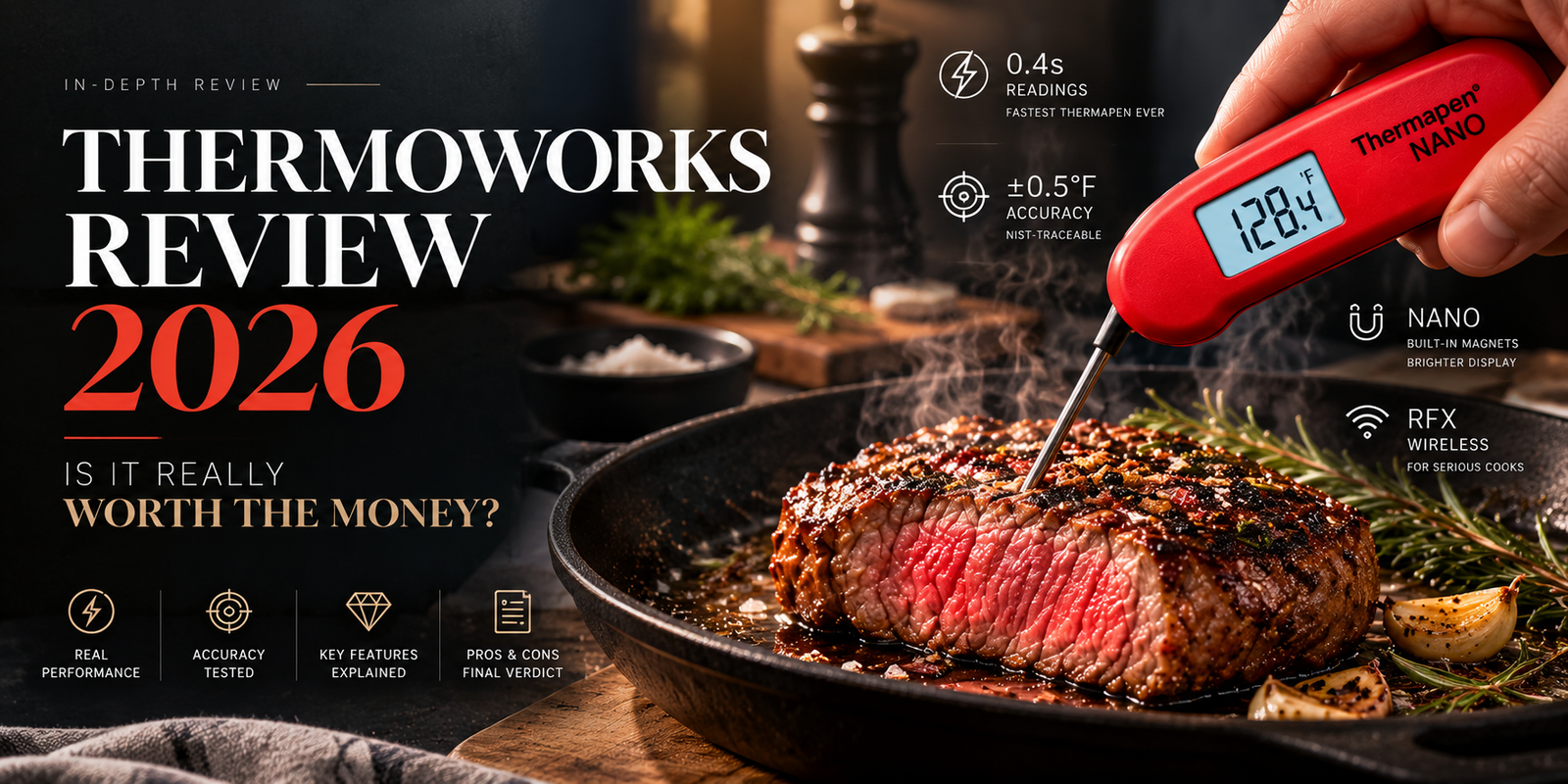
The famous Thermapen ONE, which dominated the premium instant-read category for years, now has a successor: the Thermapen NANO. ThermoWorks says the NANO can deliver readings in just 0.4 seconds, compared with the ONE’s previous one-second claim. The new model also adds built-in magnets, a brighter display and a slimmer design.
Meanwhile, the Sizzle gives buyers a mid-range alternative between the ThermoPop 2 and premium Thermapen models, while the RFX wireless system takes ThermoWorks deeper into serious BBQ territory.
So the real question isn’t simply:
“Is ThermoWorks good?”
The more useful question is:
“Is ThermoWorks good enough to justify paying more than a generic thermometer?”
Let’s find out.
ThermoWorks Review 2026: The Short Answer
If you want the short version, here it is:
Yes, ThermoWorks is one of the most compelling thermometer brands available in 2026—but not every ThermoWorks product makes sense for every cook.
The brand’s biggest strengths are accuracy, speed, thoughtful designs, calibration documentation, durability and an unusually broad ecosystem.
Independent testing backs up much of that reputation.
Food Network’s 2026 testing of the Thermapen ONE found it delivered one-second readings and accurate results in ice-water, boiling-water, chicken and steak tests.
Serious Eats has also tested a large number of thermometers and continues to feature multiple ThermoWorks products across different categories, including the new Thermapen NANO, ThermoPop 2, Sizzle and RFX.
But there is an important catch:
ThermoWorks is not the cheapest option.
And if you only cook occasionally, you may never notice the difference between a $20 thermometer and a $100+ premium model.
If you cook constantly, grill frequently, bake seriously, make candy, smoke brisket or simply demand consistency, however, the equation changes.
That’s where ThermoWorks starts making a lot more sense.
What Is ThermoWorks?
ThermoWorks is a Utah-based company known primarily for temperature measurement equipment for cooking and food service.
Its product range includes:
- Instant-read thermometers
- Wireless meat probes
- BBQ thermometers
- Cooking alarms
- Infrared thermometers
- Specialized probes
- Commercial food-service temperature tools
The company’s philosophy is easy to understand.
Temperature isn’t just another cooking measurement.
Temperature is often the difference between success and failure.
Take a steak.
A few degrees can move it from beautifully medium-rare toward medium.
Take chicken.
Under-temperature can create a food-safety issue, while excessive cooking can turn the meat dry.
Take caramel.
A small temperature difference can change the final texture.
Take bread.
Water and dough temperature influence the process.
Take brisket.
Now you’re talking about an hours-long temperature-management problem.
So a thermometer can be much more important than it initially appears.
1. Thermapen NANO: The New Star of the ThermoWorks Lineup
If you have been researching ThermoWorks, you have probably seen the Thermapen ONE everywhere.
But in 2026, there’s a new name you need to know:
Thermapen NANO.
ThermoWorks describes it as the fastest Thermapen ever, with claimed readings in 0.4 seconds and ±0.5°F accuracy. It uses a Type K thermocouple and includes a NIST-traceable calibration certificate.
And no, that isn’t simply marketing fluff.
Independent testing by Serious Eats after nearly three months of testing found the NANO lived up to its speed claims and praised its precision and usability.
But speed isn’t the only change.
The NANO adds:
- 0.4-second readings
- ±0.5°F accuracy
- 300% brighter backlight
- 360° automatic display rotation
- Built-in magnets
- IP67 waterproofing
- A slimmer body
- Five-year warranty
- NIST-traceable calibration
The magnets might sound like a tiny feature.
They aren’t.
Imagine you’re grilling and constantly putting the thermometer down.
Counter.
Grill shelf.
Cutting board.
Counter again.
Where did you put it?
The NANO can simply stick to a magnetic surface and remain within reach.
It’s one of those features that sounds boring in a specification sheet and becomes surprisingly useful in real life.
The downside?
The price.
The Thermapen NANO is positioned as a premium thermometer, currently listed by ThermoWorks at $119.
That is a lot of money for something whose primary job is to tell you a number.
But if you’re the type of person who uses a thermometer several times every week, the argument becomes much stronger.
2. Thermapen ONE: Still Excellent, Even Though It Has Been Replaced
Here’s where things get interesting.
The Thermapen ONE isn’t suddenly bad because ThermoWorks launched the NANO.
Far from it.
The ONE was already an exceptional thermometer.
Food Network tested it in steak, chicken, ice-water and boiling-water scenarios and found it delivered on its one-second reading claim and produced accurate results.
It has:
- One-second readings
- ±0.5°F accuracy in its key range
- Waterproof construction
- Backlit rotating display
- Motion-sensing wake functionality
- Folding probe
- Five-year warranty
For years, this was the ThermoWorks thermometer to beat.
Now the NANO has effectively taken the flagship position.
That actually creates an interesting opportunity for shoppers.
If the ONE is discounted or available through closeout pricing, it can potentially become a very attractive premium thermometer for someone who doesn’t need the NANO’s extra speed and newer features.
The difference between one second and 0.4 seconds isn’t going to transform your Sunday roast.
But it can matter when you’re checking multiple steaks on a hot grill or working with temperature-sensitive ingredients.
Our take:
Don’t dismiss the Thermapen ONE simply because the NANO exists.
The ONE established the reputation.
The NANO is the evolution.
3. ThermoPop 2: The ThermoWorks Most People Probably Need
Here’s where we get practical.
You don’t need to spend $119 to get into ThermoWorks.
The ThermoPop 2 is currently listed at $39 by ThermoWorks and offers a much more approachable entry point.
It provides:
- 2–3 second response time with the 4.5-inch probe
- ±1°F accuracy in key ranges
- IP67 waterproofing
- Auto-rotating backlit display
- NIST-traceable calibration certificate
- Two probe-length options
- Two-year warranty
That’s an impressive package for an everyday kitchen thermometer.
And here’s the key:
Most home cooks don’t actually need a 0.4-second reading.
If you’re checking whether your chicken has reached temperature, three seconds isn’t exactly an eternity.
If you’re checking a roast, three seconds is basically irrelevant.
If you’re making Sunday pancakes, you’re definitely not going to notice the difference.
The ThermoPop 2 therefore makes a lot of sense for the everyday cook.
It gives you the fundamental ThermoWorks philosophy—measure temperature accurately—without forcing you into the premium price bracket.
Best for:
Home cooks, beginners, casual grillers and anyone who wants reliable temperature readings without spending a fortune.
4. ThermoWorks Sizzle: The Middle Child That Actually Makes Sense
The Sizzle might be one of the most interesting additions to the ThermoWorks lineup.
Why?
Because there is a huge gap between cheap thermometers and premium thermometers.
The Sizzle sits right in that middle.
Independent testing from Serious Eats found the Sizzle offered strong accuracy and useful features while averaging around 3.3 seconds in testing—slower than the Thermapen ONE but still faster than the ThermoPop 2.
The Sizzle also features:
- 270° rotating probe
- Backlit display
- Magnetic body
- Adjustable sleep timer
- Waterproof construction
- Around two-second advertised response characteristics
- ±0.9°F stated accuracy
The 270° probe rotation is actually an interesting design advantage.
It gives you more flexibility when checking food from awkward angles.
The magnetic body is another small but useful touch.
And because it sits below the premium Thermapen models in price, it can make more sense for someone who wants a nicer everyday thermometer without jumping all the way to flagship pricing.
Our take:
The Sizzle is the “I want good stuff, but I’m not trying to impress Gordon Ramsay” option.
And that’s not an insult.
That’s a massive market.
5. RFX MEAT: Where ThermoWorks Gets Seriously High-Tech
Now let’s leave the kitchen counter and walk into the BBQ world.
The RFX MEAT is ThermoWorks’ wireless probe system designed for long cooking sessions.
And this is where the brand’s engineering becomes particularly interesting.
Instead of relying solely on Bluetooth, RFX uses a Sub-1 GHz radio system through the RFX GATEWAY. ThermoWorks lists a line-of-sight wireless range of up to 1,500 feet and an external operating range reaching 1,000°F.
The probe is also rated IP69K waterproof.
That’s serious hardware.
Independent reviews have been particularly positive about the RFX’s reliability and accuracy.
A September 2026 Weber Kettle Club review reported more than a dozen slow cooks and several reverse-seared steaks, with the reviewer finding the probes accurate enough to match their Thermapen in real-world testing.
But there are caveats.
The ambient pit probe remains wired, and some reviewers have noted mounting and integration limitations depending on the grill setup.
That means RFX isn’t some magical completely cable-free cooking universe.
But it solves one of the biggest annoyances with wireless cooking:
the meat probe itself doesn’t need a wire running out of your cooker.
For brisket?
Fantastic.
For overnight pork shoulder?
Fantastic.
For reverse-seared steak?
Also fantastic.
For someone cooking two burgers on Tuesday?
Probably ridiculous.
6. ChefAlarm: The Unsexy Product You Might End Up Loving
Not every great kitchen product needs to look futuristic.
The ChefAlarm is a classic example.
It is a leave-in cooking thermometer with alarms and temperature monitoring designed for tasks where you don’t want to stand over the food.
Think roast chicken.
Prime rib.
Frying.
Candy.
Sauces.
Slow roasting.
The advantage is simple:
You can stop staring at the oven.
Set your target temperature.
Insert the probe.
Wait for the alarm.
Continue doing something else.
It’s an old-school solution to a very modern problem:
Nobody has enough attention anymore.
If your cooking routine involves multitasking, ChefAlarm can be more useful than a flashy instant-read thermometer.
7. BlueDOT: Remote Monitoring Without Going Full Pitmaster
The BlueDOT sits between a basic leave-in thermometer and a full BBQ monitoring system.
It uses Bluetooth and connects to the ThermoWorks app, allowing you to monitor temperatures remotely.
This makes sense for cooks who want to put something in the oven and walk away.
It is particularly useful for long roasting sessions.
You don’t need to stand next to the oven.
You don’t need to keep opening the door.
You can monitor the temperature and let the cooking process continue.
The important thing to understand is that Bluetooth has limitations.
You aren’t getting the same kind of long-range flexibility as the RFX ecosystem.
So BlueDOT is best viewed as a convenient remote-monitoring tool, not a replacement for a high-end wireless BBQ network.
8. Infrared Thermometers: The Secret Weapon for Pizza and Pans
Here’s where people often misunderstand thermometers.
Not every thermometer is designed to measure the temperature inside food.
Infrared thermometers measure surface temperature.
That makes them extremely useful for things like:
- Pizza stones
- Cast-iron pans
- Griddles
- Grill surfaces
- Baking surfaces
- Frying equipment
This is where ThermoWorks’ infrared products become interesting.
Imagine making pizza at home.
You don’t necessarily care what temperature the air inside the oven claims to be.
You care about the temperature of the surface your pizza is actually touching.
That’s a completely different measurement.
And once you start thinking about cooking in those terms, infrared thermometers become much more useful.
They aren’t competitors to an instant-read thermometer.
They’re solving a different problem.
9. ThermoWorks’ Biggest Advantage: The Ecosystem
This might actually be the company’s biggest strength.
ThermoWorks doesn’t force you to buy one universal device that tries to do everything.
Instead, it has different tools for different jobs.
Need speed?
Thermapen NANO.
Need affordability?
ThermoPop 2.
Want the middle ground?
Sizzle.
Need long-range wireless monitoring?
RFX.
Need leave-in alarms?
ChefAlarm.
Need Bluetooth monitoring?
BlueDOT.
Need surface temperature?
Infrared.
That’s a good product philosophy.
Because the best thermometer for a steak isn’t necessarily the best thermometer for a brisket.
And the best thermometer for a brisket isn’t necessarily the best tool for a pizza oven.
Trying to make one device do everything usually means compromising somewhere.
ThermoWorks largely avoids that.
10. Is ThermoWorks Actually More Accurate?
This is where we need to be careful.
A brand can claim incredible accuracy.
That doesn’t automatically make it true.
The encouraging part is that independent testers have repeatedly put ThermoWorks products through practical tests.
Food Network’s testing of the Thermapen ONE included ice-water and boiling-water checks as well as actual steak and chicken cooking tests, with the thermometer matching the expected temperatures.
AmazingRibs also maintains detailed testing of ThermoWorks products and notes features such as calibration resolution, backlighting and display behavior.
And recent reviews of the RFX have similarly found strong accuracy in real-world cooking situations.
That doesn’t mean every ThermoWorks product is magically more accurate than every competing thermometer.
It means the brand has developed a strong reputation for repeatable, well-specified temperature measurement, and independent testing generally supports that reputation.
That’s a much more useful conclusion.
ThermoWorks Pros and Cons
What We Like
Extremely strong accuracy reputation
Independent testing consistently supports the brand’s accuracy claims across several product categories.
Very fast instant-read options
The Thermapen NANO’s claimed 0.4-second response is frankly ridiculous—in the best possible way.
Excellent variety
There is a ThermoWorks solution for almost every temperature-monitoring problem.
Great displays
Large, rotating, backlit displays are especially useful when you’re cooking in awkward positions or low light.
Strong build quality
Waterproofing, rugged housings and long warranties are common across the lineup.
Calibration documentation
NIST-traceable calibration certificates add an extra layer of confidence for buyers who care about measurement accuracy.
Serious BBQ capabilities
The RFX system gives ThermoWorks a compelling answer for people who want wireless monitoring during long cooks.
What We Don’t Like
The price
This is the obvious one.
ThermoWorks products are not bargain-bin gadgets.
You can buy an inexpensive thermometer for a fraction of the price.
The question is whether the extra performance and durability matter to you.
Too many choices
Ironically, ThermoWorks’ biggest strength can also be a weakness.
Thermapen NANO.
Thermapen ONE.
Sizzle.
ThermoPop 2.
RFX.
ChefAlarm.
BlueDOT.
Smoke.
Infrared.
Probes.
It can get confusing quickly.
Some products overlap
For example, a casual cook may struggle to understand why they should spend more on Sizzle when ThermoPop 2 exists—or why they need NANO when a cheaper thermometer can tell them whether their chicken is done.
That’s why buying according to your cooking style is more important than simply buying the most expensive model.
Wireless systems aren’t magic
RFX is impressive, but you still have to understand the gateway, app, ambient probe and battery requirements.
The technology is powerful, but it adds complexity compared with sticking a simple instant-read thermometer into a steak.
ThermoWorks vs Cheap Thermometers: Is the Extra Money Worth It?
This is the question most readers actually want answered.
Suppose you find a $15 thermometer online.
It says it reads quickly.
It has thousands of reviews.
It looks almost identical to something costing $100.
Why spend more?
The answer isn’t:
“Because expensive automatically means better.”
It doesn’t.
The answer is that premium ThermoWorks models generally sell you more than a temperature number.
You are paying for:
Speed.
Accuracy.
Calibration verification.
Build quality.
Display quality.
Water resistance.
Warranty.
Ergonomics.
Reliability.
And, with products like RFX, you’re paying for an entire monitoring ecosystem.
For someone who cooks twice a month, that may not be worth it.
For someone who grills every weekend?
Different story.
For a professional kitchen?
Even more different.
Which ThermoWorks Should You Buy in 2026?
Here’s the easiest way to think about it.
If money isn’t your biggest concern:
Thermapen NANO
You’re buying the newest premium instant-read experience, with 0.4-second readings and a redesigned feature set.
If you want a premium thermometer but find the NANO excessive:
Thermapen ONE
Especially interesting if you find it discounted during the transition to the NANO.
If you want affordable ThermoWorks:
ThermoPop 2
At $39 on ThermoWorks’ current product page, it’s one of the easiest ways into the ecosystem.
If you want the middle ground:
Sizzle
It offers a strong mix of speed, accuracy and useful design features without going all the way to flagship pricing. Independent testing has found it accurate, though slower than the premium Thermapen models.
If you’re a serious BBQ enthusiast:
RFX MEAT
Especially if you regularly smoke, roast or reverse-sear and want wireless monitoring.
If you want surface temperatures:
An infrared ThermoWorks model
Especially useful for pizza, griddles, pans and grills.
Our ThermoWorks Review 2026 Rating
Based on the current lineup, published specifications and independent testing, here’s how we would describe the brand rather than pretending every product deserves the same score:
Accuracy: Excellent
Speed: Excellent on premium instant-read models
Build quality: Excellent
Product variety: Excellent
Ease of use: Very good to excellent
Innovation: Excellent
Value: Very good, but highly dependent on the product
Budget friendliness: Good on ThermoPop 2, less so on premium models
BBQ ecosystem: Excellent
Overall: A very strong premium temperature-tool ecosystem
The important thing is that this isn’t a claim that every ThermoWorks product is the best choice for every person.
It’s the opposite.
The brand makes more sense when you pick the product that matches your cooking style.
Final Verdict: Is ThermoWorks Worth It in 2026?
After looking at the current lineup, independent testing and the changes ThermoWorks has made in 2026, the answer is fairly straightforward.
ThermoWorks is worth considering if you care about precision, consistency and reliability.
But don’t buy a ThermoWorks thermometer simply because somebody online told you that you need the most expensive one.
You probably don’t.
If you are an everyday home cook, the ThermoPop 2 can give you a lot of what you actually need.
If you want something faster and more refined, the Sizzle is an interesting middle ground.
If you want the premium instant-read experience, the Thermapen NANO is now the product to watch.
And if you’re the person who has a smoker running overnight, checks brisket temperatures at 2 a.m. and gets genuinely excited when a pork shoulder develops perfect bark…
You’re probably the RFX customer.
That’s ultimately what makes ThermoWorks interesting.
It isn’t really selling “a thermometer.”
It is selling confidence in your cooking.
You don’t have to wonder whether your steak is ready.
You can check.
You don’t have to keep opening your smoker.
You can monitor it.
You don’t have to guess whether your pizza stone is hot enough.
You can measure it.
And you don’t have to rely entirely on cooking time when the actual temperature is telling you a much more useful story.
That’s the real value.
Not the number on the thermometer.
The number you can trust.
Want to Explore ThermoWorks Products?
If you’re still deciding which model fits your cooking style, we’ve put together a dedicated ThermoWorks guide covering the brand’s most interesting products, their use cases and what makes each one different.
Explore our ThermoWorks guide on Top10Techies →
It can be a useful starting point before jumping straight into a premium thermometer.
And remember:
You don’t need the most expensive thermometer in the kitchen.
You need the right thermometer for the way you cook.
Disclosure: This article contains affiliate links. If you purchase a product through our affiliate link, Top10Techies may earn a commission at no additional cost to you. This helps support our website and allows us to continue creating product research and technology content.